
 By abdul aziz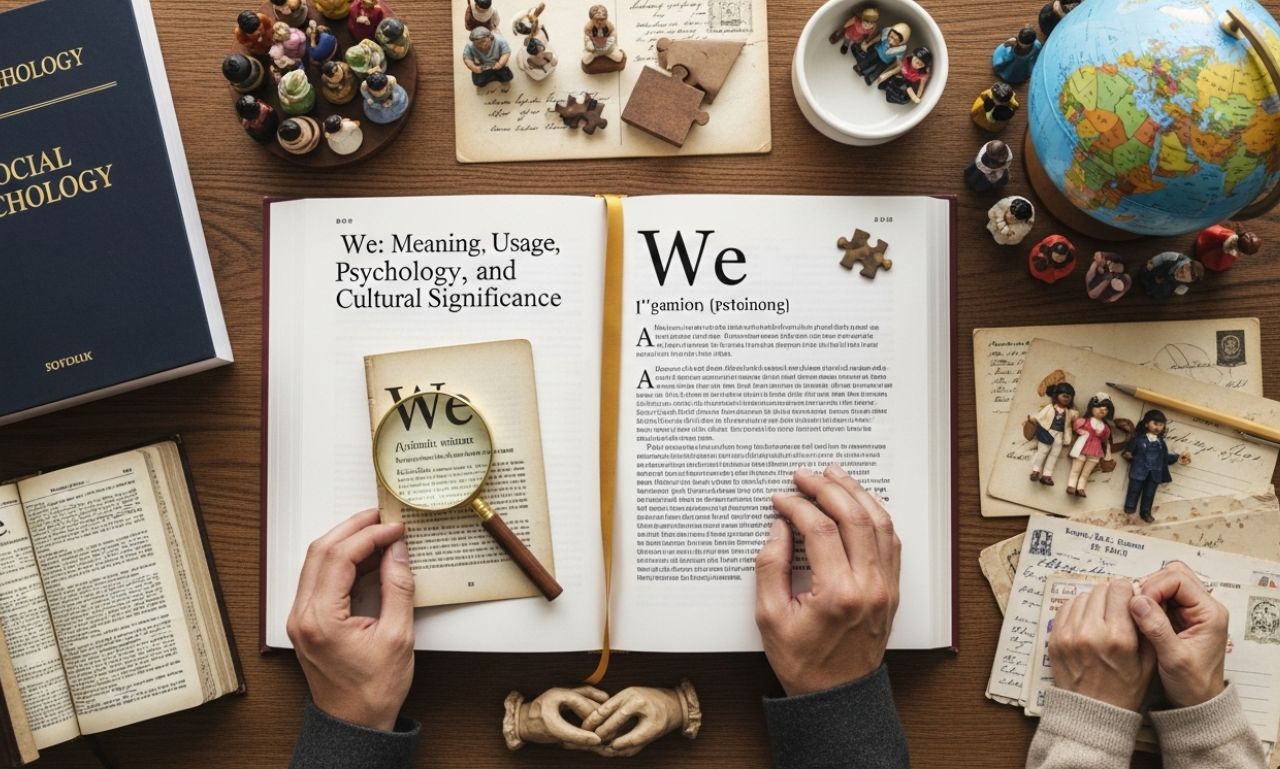
The word we may seem simple, but it carries powerful meaning in language, psychology, politics, literature, and everyday communication. From expressing unity to representing shared responsibility, we plays a major role in shaping relationships and group identity. In this article, we will explore the meaning of we, its grammatical function, psychological impact, cultural relevance, and how it influences communication across different contexts.
What Does We Mean?
At its most basic level, w e is a first-person plural pronoun. It refers to a group that includes the speaker and at least one other person. Unlike “I,” which focuses on an individual, w e emphasizes togetherness and shared experience.
For example:
-
“W e are going to the meeting.”
-
“W e believe in fairness.”
In both sentences, the speaker includes themselves as part of a group. This inclusion is what gives w e its sense of unity.
The Grammar of We
We as a Subject Pronoun
In English grammar, w e functions as a subject pronoun. It replaces a noun phrase that includes the speaker and others.
Examples:
-
John and I → W e
-
My friends and I → W e
The objective form of w e is “us,” and the possessive forms are “our” and “ours.”
Inclusive vs Exclusive We
Although English does not formally distinguish between inclusive and exclusive forms of we, many other languages do.
-
Inclusive w e includes the listener.
Example: “W e should start now.” -
Exclusive w e excludes the listener.
Example: “W e have already decided.”
The meaning depends heavily on context.
The Psychological Power of We
The word we carries emotional and psychological weight. It creates a sense of belonging and shared identity.
Building Connection
When leaders say “we,” it makes people feel included. For instance, during speeches, politicians often use we to create unity and collective responsibility.
Famous speeches such as those delivered by Martin Luther King Jr. frequently used collective language to inspire unity and social change.
Strengthening Team Spirit
In sports, coaches use w e to build team morale:
-
“W e win together.”
-
“W e learn from our mistakes.”
This approach reinforces teamwork rather than individual blame.
We in Literature
One of the most notable uses of the word appears in the novel W e by Yevgeny Zamyatin. This dystopian story explores a society where individuality is suppressed in favor of collective identity.
In this novel, the concept of w e represents state control and the loss of personal freedom. The book later influenced works like 1984 and Brave New World.
Here, w e is not just a pronoun—it becomes a symbol of enforced unity.
We in Politics and Leadership
The Language of Unity
Political leaders often use w e to promote solidarity. For example:
-
“W e must work together.”
-
“W e face challenges ahead.”
Using w e can make citizens feel involved in decision-making.
The Risk of Manipulation
However, w e can also be used strategically to avoid accountability. Saying “We made mistakes” can sometimes blur individual responsibility.
This shows that the word w e is powerful but context-dependent
Cultural Interpretations of We
Different cultures place varying emphasis on collective identity.
Individualistic Societies
In countries that value individual achievement, such as the United States, the word “I” is often prominent. Personal success and independence are highly valued.
Collectivist Societies
In more collectivist cultures, group harmony and shared goals are emphasized. In these contexts, w e is used more frequently in daily communication.
Cultural background influences how often and how strongly people identify with group language.
We in Relationships
Romantic Relationships
In healthy relationships, couples often transition from “I” to “w e” language:
-
“W e are planning our future.”“W e decided together.”
Psychologists suggest that couples who use more w e language may experience stronger emotional bonds.
Family Dynamics
Families naturally rely on w e statements:
-
“W e support each other.”
-
“W e celebrate together.”
This shared identity fosters belonging.
The Business Use of We
Companies frequently use w e in branding:
-
“W e care about our customers.”
-
“W e innovate for you.”
This language helps businesses appear inclusive and customer-focused.
However, customers can detect insincerity. Authentic use of we strengthens trust, while overuse may feel corporate or impersonal.
We in Social Media and Online Communities
On social media platforms, users often form communities around shared interests. Statements like:
-
“W e love this show.”
-
“W e stand for change.”
These expressions build group identity and solidarity.
Online movements often rely heavily on collective language to gain momentum.
Philosophical Perspective on We
Philosophers have long debated the balance betw een individuality and collectivism. The tension betw een “I” and “w e” shapes debates about freedom, responsibility, and society.
Too much emphasis on w e may suppress individuality. Too much emphasis on I may w eaken community bonds. A healthy society often requires balance between the two.
Why We Matters in Everyday Life
Although small, w e influences how w e see ourselves in relation to others. It can:
-
Build unity
-
Encourage cooperation
-
Strengthen relationships
-
Inspire social movements
-
Promote teamwork
At the same time, it can obscure responsibility if used carelessly.
Understanding the power of w e allows for more mindful communication.
Conclusion
The word w e is far more than a simple pronoun. It represents unity, shared identity, and collective responsibility. From grammar and psychology to politics and literature, w e shapes how people connect with each other.
Whether used in speeches by leaders like Martin Luther King Jr., explored in dystopian novels such as W e, or spoken in everyday conversations, w e carries emotional depth and social influence.
By recognizing the power of w e, we can communicate more effectively and build stronger communities.