
 By abdul aziz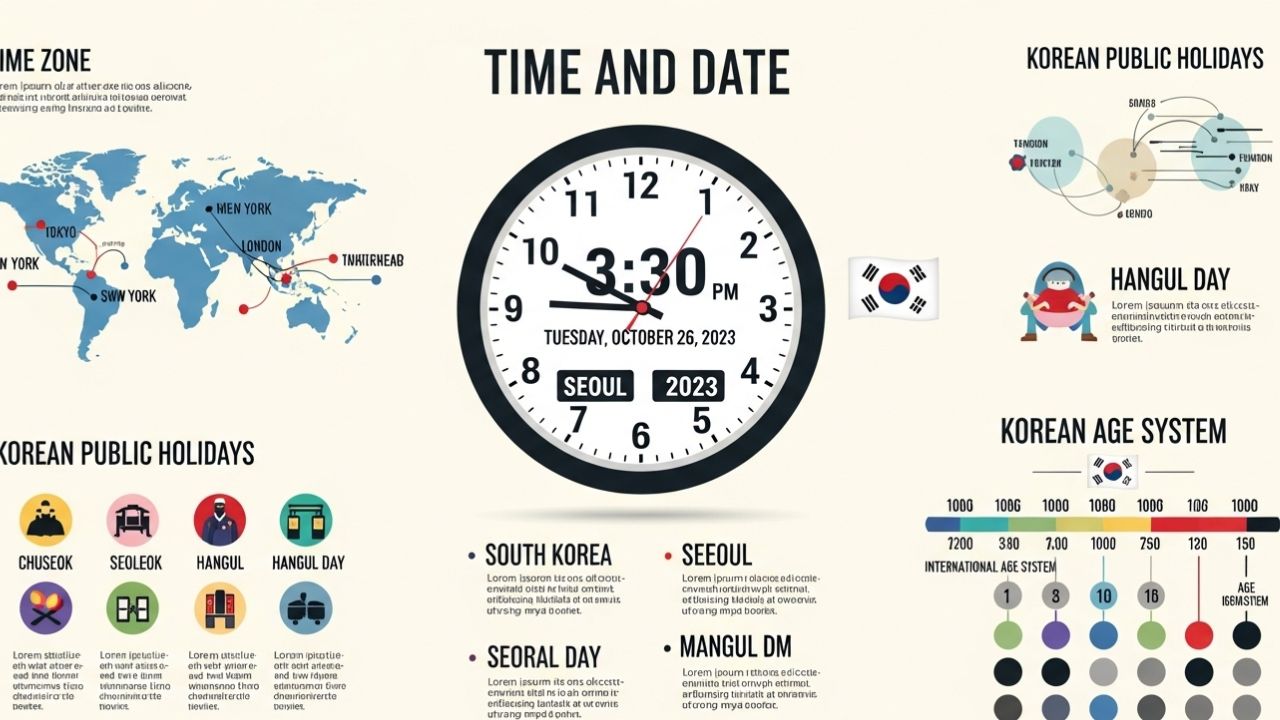
Understanding time and date in South Korea is crucial for travelers, international business, remote work, and daily planning across different regions. South Korea, officially the Republic of Korea, follows a single time zone across the entire country and uses the Gregorian calendar to organize dates. Whether you’re scheduling a virtual meeting with someone in Seoul, planning a vacation in Busan, or coordinating events internationally, knowing the time and date in South Korea ensures accuracy and convenience. In this article, we’ll explore how local time works, the standard date formats, and how South Korea’s clock aligns with global time standards.
Korea Standard Time: The Local Time in South Korea
What Is Korea Standard Time
South Korea operates on Korea Standard Time (KST), which is UTC+9 hours. This means that clocks in South Korea are nine hours ahead of Coordinated Universal Time (UTC). Unlike some countries, South Korea has one uniform time zone across the nation, including Seoul, Busan, Incheon, Daegu, and Gwangju. (timeanddate.com)
No Daylight Saving Time
South Korea does not observe daylight saving time, meaning the clocks remain the same year-round. This simplifies scheduling for travel, business, and international calls, as there are no seasonal changes to adjust for. Historically, DST was tested during events such as the 1988 Seoul Olympics, but it is no longer used.
How Time Affects Daily Life
The consistency of time and date in South Korea ensures smooth daily routines. Work hours, public transportation, television programming, and school schedules all rely on KST. For international communication, this means you can easily calculate the time difference between South Korea and other countries to schedule meetings or calls effectively.
The Date System in South Korea
Gregorian Calendar
South Korea uses the Gregorian calendar, the same calendar system followed by most of the world. The year is divided into 12 months, with 28–31 days per month depending on the month, and leap years adding an extra day in February.
Date Format
In South Korea, dates are typically written year-month-day, with the Korean words for year (년), month (월), and day (일). For example, 2026년 4월 4일 corresponds to April 4, 2026. In numeric form, it is often written as 2026.04.04. (en.wikipedia.org/wiki/Date_and_time_notation_in_South_Korea)
Spoken Dates
When speaking about dates, Koreans also follow the year-month-day order, making it consistent with the written format. This standardization helps in business, education, and cultural planning.
Time Notation: 12-Hour vs 24-Hour Clock
South Korea commonly uses both 12-hour and 24-hour time formats.
- 12-hour format: Often used in casual conversations, social media, and informal schedules.
- 24-hour format: Common in official schedules such as transportation timetables, flight schedules, TV programming, and digital devices.
For instance, 2:30 PM would be expressed as 14:30 in the 24-hour format and 오후 2:30 in spoken Korean using the 12-hour format.
Comparing South Korea Time to Other Regions
Since South Korea is UTC+9, it is significantly ahead of many countries:
- London (UTC+0) → 9 hours behind
- New York (UTC-5/UTC-4) → 13–14 hours behind depending on daylight saving time in the U.S.
- Tokyo (UTC+9) → Same time as South Korea
- Sydney (UTC+10/UTC+11) → 1–2 hours ahead depending on Australian daylight saving time
This time difference is important for international business, travel planning, and scheduling virtual meetings.
Importance of Knowing the Time and Date in South Korea
Travel and Tourism
For travelers, knowing the time and date is essential for adjusting to the local time, planning flights, hotel check-ins, and daily itineraries. Jet lag can be minimized by understanding the time difference in advance.
Business and Communication
South Korea is a major global economic hub, with industries in technology, finance, education, and entertainment. Scheduling meetings across time zones requires awareness of Korea Standard Time to avoid late-night calls or missed deadlines.
Cultural and Public Events
National holidays like Seollal (Korean New Year) and Chuseok (Harvest Festival) are based on the lunar calendar but correspond to specific dates on the Gregorian calendar each year. Understanding the local date helps participate in these celebrations or plan business closures.
Tools to Check Time and Date in South Korea
Online World Clock
Websites like timeanddate.com allow you to quickly see the current time and date in South Korea and compare it with your location.
Smartphone Apps
Most smartphones have world clock features that let you add Seoul or other South Korean cities to your clock, giving real-time updates.
Calendars and Scheduling Tools
Digital calendars like Google Calendar or Microsoft Outlook automatically adjust for Korea Standard Time, making international scheduling seamless.
Common Questions About Time and Date in South Korea
Does South Korea have daylight saving time?
No, South Korea remains on Korea Standard Time (UTC+9) all year.
How is the date spoken in Korea?
The date is spoken in year-month-day order, consistent with the written format. For example, “2026년 4월 4일” for April 4, 2026.
Can I use the 24-hour clock?
Yes, the 24-hour format is commonly used for official timetables, transportation, and formal schedules.
Conclusion
Understanding the time and date in South Korea is essential for smooth travel, international communication, and cultural participation. South Korea uses Korea Standard Time (UTC+9) without daylight saving changes and the Gregorian calendar in a year-month-day format. Whether you are visiting Seoul, doing business internationally, or coordinating virtual events, knowing the local time and date ensures accuracy, efficiency, and cultural awareness.