
 By abdul aziz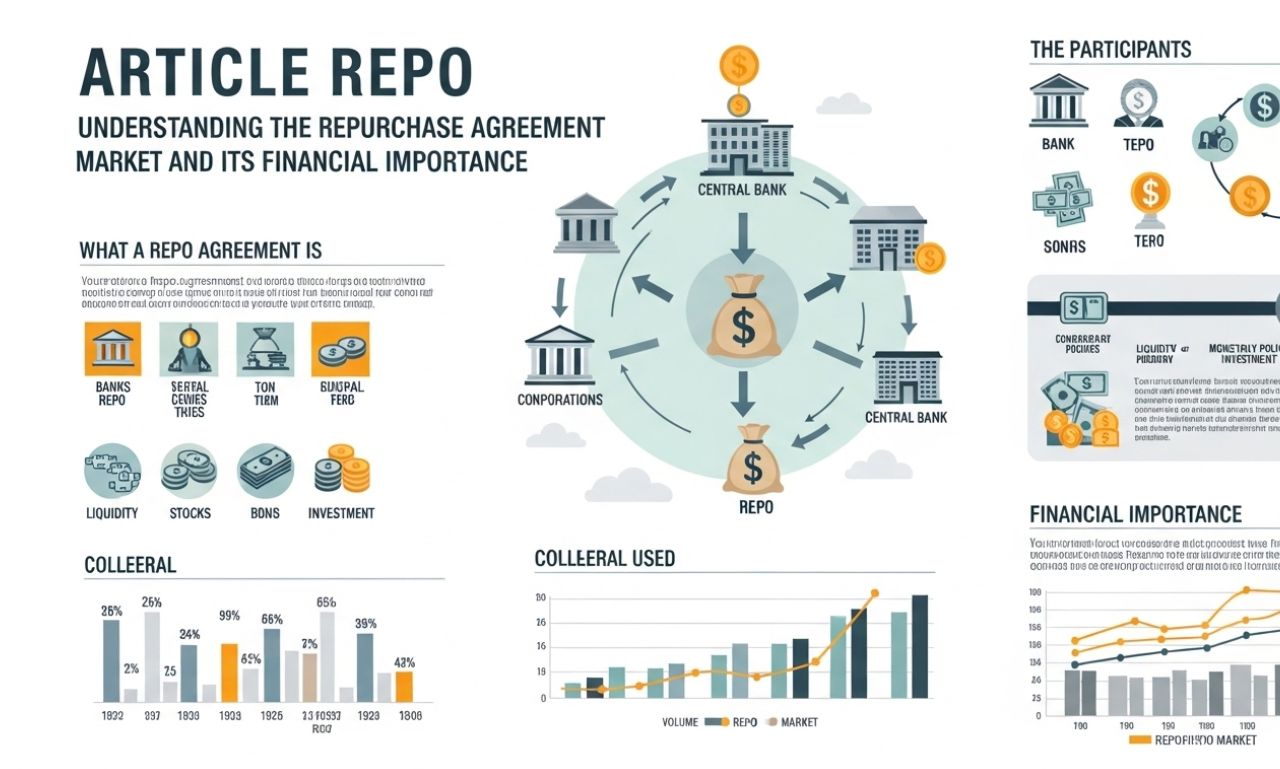
The term Article Repo refers to an in-depth discussion about repurchase agreements, commonly known as repos, and their vital role in the global financial system. A repo is a short-term borrowing mechanism primarily used by banks, financial institutions, and central banks to manage liquidity. In this Article Repo, we will explore what repos are, how they work, their types, benefits, risks, and their impact on modern financial markets.
What Is a Repo?
To fully understand this Article Repo, it is essential to define what a repurchase agreement is. A repo is a short-term financial transaction in which one party sells securities to another party with an agreement to repurchase them at a predetermined price on a specific future date.
In simple terms, a repo functions like a collateralized loan:
-
One party needs cash.
-
It sells securities (usually government bonds).
-
It agrees to buy them back later at a slightly higher price.
The difference between the sale price and the repurchase price represents the interest earned by the lender.
Repos are widely used in money markets to ensure smooth financial operations and liquidity flow.
How Repo Transactions Work
In this Article Repo, let’s break down the mechanics of a typical repo transaction:
-
Initial Sale – The borrower sells high-quality securities to a lender.
-
Agreement to Repurchase – Both parties agree on a future date and price.
-
Repurchase Date – The borrower buys back the securities at the agreed price.
The securities act as collateral, reducing risk for the lender. Most repo agreements are overnight transactions, but some can extend for weeks or months.
The interest rate applied in these agreements is called the repo rate, which plays a crucial role in the broader financial system.
Types of Repo Agreements
There are different types of re pos that financial institutions use:
1. Overnight
An overnight re po lasts for just one day. It is commonly used to meet short-term liquidity needs.
2. Term
A term re po lasts longer than one day, sometimes weeks or months, depending on the agreement.
3. Open
An open re po does not have a fixed end date. It continues until one party decides to terminate it.
Each of these variations serves different financial purposes, but all follow the same fundamental principle described in this Article Re po.
Role of Central Banks
Central banks play a significant role in the re po market. For example, the Federal Reserve uses repos to inject liquidity into the banking system. Similarly, the Bank of England conducts repo operations to main tain monetary stability.
When a central bank wants to increase money supply, it buys securities through re po agreements. When it wants to reduce liquidity, it conducts reverse repos.
Thus, repos are powerful tools in monetary policy implementation.
What Is a Reverse Repo?
A reverse repo is essentially the opposite side of a re po transaction. In this case:
-
The lender buys securities.
-
The borrower agrees to repurchase them later.
From the central bank’s perspective, reverse repos help absorb excess liquidity from the market.
Reverse repo rates often signal changes in monetary policy and influence short-term interest rates.
Why the Repo Market Matters
The r epo market is critical for several reasons:
1. Liquidity Management
Financial institutions rely on repos for quick access to cash without permanently selling assets.
2. Monetary Policy Tool
Central banks use re po operations to control inflation and stabilize the economy.
3. Low-Risk Lending
Since repos are backed by collateral, they are generally considered safer than unsecured loans.
4. Financial Market Stability
A well-functioning re po market supports bond markets, interbank lending, and overall financial stability.
The importance highlighted in this Article Repo shows how deeply interconnected repos are with global finance.
Risks Associated with Repo Transactions
Despite their relative safety, repos are not risk-free. This Article Re po would be incomplete without discussing potential risks:
1. Counterparty Risk
If the borrower defaults, the lender must rely on the collateral’s value.
2. Market Risk
If the collateral loses value, it may not fully cover the loan amount.
3. Liquidity Risk
In times of financial stress, re po markets can freeze, as seen during the 2008 financial crisis.
4. Systemic Risk
Large disruptions in re po markets can affect banks and global financial systems.
Proper regulation and monitoring help mitigate these risks.
Repo Rate and Its Economic Impact
The repo rate directly affects short-term interest rates in an economy. When central banks adjust repo rates:
-
Borrowing costs change.
-
Bank lending rates may rise or fall.
-
Inflation and economic growth can be influenced.
For example, during economic slowdowns, central banks may lower r epo rates to stimulate borrowing and investment. During inflationary periods, rates may increase to control excessive spending.
This makes the re po rate a key indicator for economists, investors, and policymakers.
Global Repo Market Trends
The global re po market involves trillions of dollars in daily transactions. Government securities, particularly treasury bonds, are the most common collateral.
Major financial hubs such as New York, London, and Tokyo have active re po markets that support international trade and finance.
In recent years, increased regulatory oversight has strengthened re po market transparency and stability.
Conclusion
This comprehensive Article Re po has explained how repurchase agreements function, why they matter, and how they influence global financial stability. Repos are more than short-term loans — they are fundamental tools for liquidity management, monetary policy, and economic balance.
From central banks to private financial institutions, repos play a crucial role in ensuring smooth operations within financial markets. While risks exist, proper regulation and collateralization make repos one of the safest forms of short-term borrowing.
Understanding repos provides valuable insight into how modern economies maintain stability and manage financial flows efficiently.