
 By abdul aziz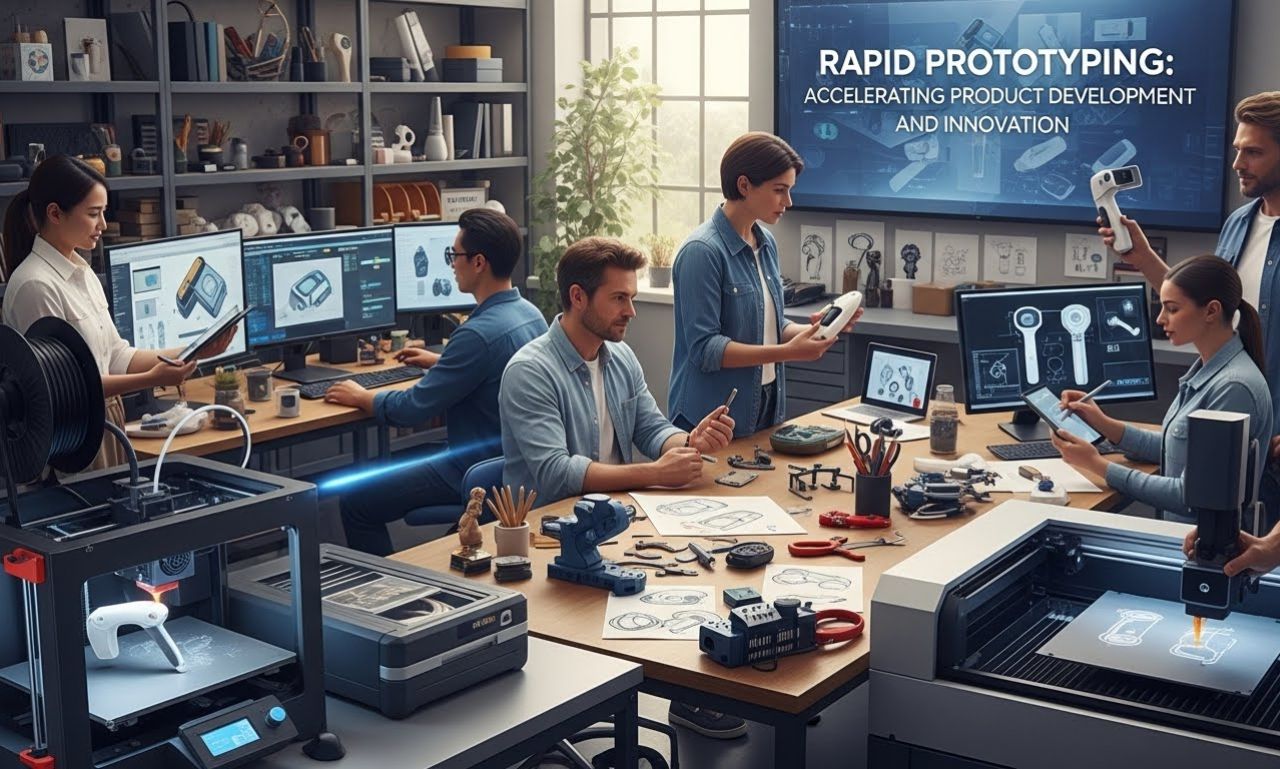
In the modern world of design and manufacturing, speed and accuracy are essential. Rapid proto typing has emerged as a crucial process for quickly turning ideas into tangible models, allowing designers, engineers, and businesses to test, evaluate, and improve products before mass production.
By creating physical or digital prototypes rapidly, teams can identify design flaws, improve functionality, and reduce time-to-market. This article explores the concept, methods, benefits, applications, and challenges of rapid proto typing in various industries.
What Is Rapid Prototyping?
Rapid proto typing (RP) is a set of techniques used to fabricate a scale model or prototype of a product quickly using three-dimensional (3D) computer-aided design (CAD) data. Unlike traditional manufacturing, which can take weeks or months, RP focuses on speed and flexibility, often producing prototypes in hours or days.
These prototypes allow designers to visualize and test products, evaluate ergonomics, functionality, and structural integrity, and make adjustments before committing to full-scale production.
Key Methods of Rapid Prototyping
1. 3D Printing (Additive Manufacturing)
3D printing is one of the most widely used RP methods. It builds objects layer by layer from materials such as plastics, resins, or metals, allowing for complex geometries that would be difficult with traditional manufacturing.
2. Stereolithography (SLA)
SLA uses ultraviolet lasers to cure liquid resin into precise 3D models. It produces high-detail prototypes with smooth surfaces, commonly used in medical devices, jewelry, and engineering designs.
3. Fused Deposition Modeling (FDM)
FDM extrudes melted thermoplastic layer by layer to build a prototype. It is cost-effective, versatile, and widely used in both industrial and home settings.
4. Selective Laser Sintering (SLS)
SLS fuses powdered materials like plastics or metals using a laser, allowing creation of durable, functional prototypes suitable for stress testing and end-use simulations.
5. CNC Machining
CNC machining is a subtractive process where a solid block of material is cut into the desired shape. It is ideal for prototypes that require durability and precision, particularly in metal parts.
Benefits of Rapid Prototyping
1. Speeds Up Product Development Rapid prototyping
Rapid proto typing reduces design-to-production time, enabling faster testing, iteration, and refinement.
2. Cost Efficiency Rapid prototyping
By identifying design flaws early, RP minimizes costly errors during mass production. Less material is wasted compared to traditional trial-and-error methods.
3. Enhances Design Accuracy Rapid prototyping
Physical prototypes provide a tangible representation of the product, helping teams verify dimensions, ergonomics, and functionality before final production.
4. Improves Communication Rapid prototyping
Prototypes act as visual aids for stakeholders, clients, and engineers, reducing misunderstandings and facilitating better decision-making.
5. Encourages Innovation Rapid prototyping
Rapid iteration allows designers to experiment with multiple ideas, fostering creativity and innovative solutions.
Applications of Rapid Prototyping
1. Automotive Industry
Automakers use rapid proto typing to design engines, body panels, and interiors, reducing development time and testing performance before production.
2. Aerospace and Aviation
RP enables engineers to create lightweight, high-strength components, test aerodynamics, and improve safety features in aircraft and spacecraft.
3. Medical Devices
From surgical instruments to prosthetics, rapid proto typing allows precise, customized models that meet patient-specific needs.
4. Consumer Electronics
Smartphones, wearable devices, and other gadgets undergo multiple rapid prototypes to refine usability, design, and functionality.
5. Architecture and Construction
Architects create scale models of buildings and structures to visualize designs, assess structural integrity, and present projects to clients.
Challenges of Rapid Prototyping
1. Material Limitations
Prototypes may not always replicate the mechanical properties of production materials, which can affect functional testing.
2. Equipment Costs
Advanced RP machines like SLA and SLS printers can be expensive, limiting accessibility for small businesses or startups.
3. Post-Processing Requirements
Some prototypes need additional finishing to improve surface quality, color, or durability, adding extra time and cost.
4. Design Constraints
Certain methods may impose limitations on shape, size, or material type, requiring careful planning in the design stage.
Best Practices for Effective Rapid Prototyping
-
Start with detailed CAD models: Ensures accurate and efficient prototypes.
-
Choose the right RP method: Match material, cost, and functionality requirements.
-
Iterate quickly: Frequent testing and modifications improve final product quality.
-
Incorporate stakeholder feedback: Reduces costly mistakes and ensures project alignment.
-
Understand material properties: Ensure realistic testing and performance results.
Future Trends in Rapid Prototyping
-
Advanced Materials: Biocompatible resins, composite powders, and conductive filaments expand possibilities.
-
AI Integration: Artificial intelligence can optimize designs, predict failures, and accelerate iteration cycles.
-
Sustainable RP: Recyclable and eco-friendly materials are being developed to reduce environmental impact.
-
Enhanced Precision and Speed: Next-generation machines provide faster production with greater accuracy.
Conclusion
Rapid proto typing has revolutionized the way products are designed, tested, and manufactured. Its ability to accelerate development, reduce costs, and promote innovation makes it indispensable in industries ranging from automotive and aerospace to medical devices and consumer electronics. By integrating rapid proto typing into product development workflows, businesses can bring ideas to market faster while maintaining high-quality standards.
Whether for functional testing, design validation, or innovation exploration, rapid protot yping continues to shape the future of manufacturing and design.