
 By abdul aziz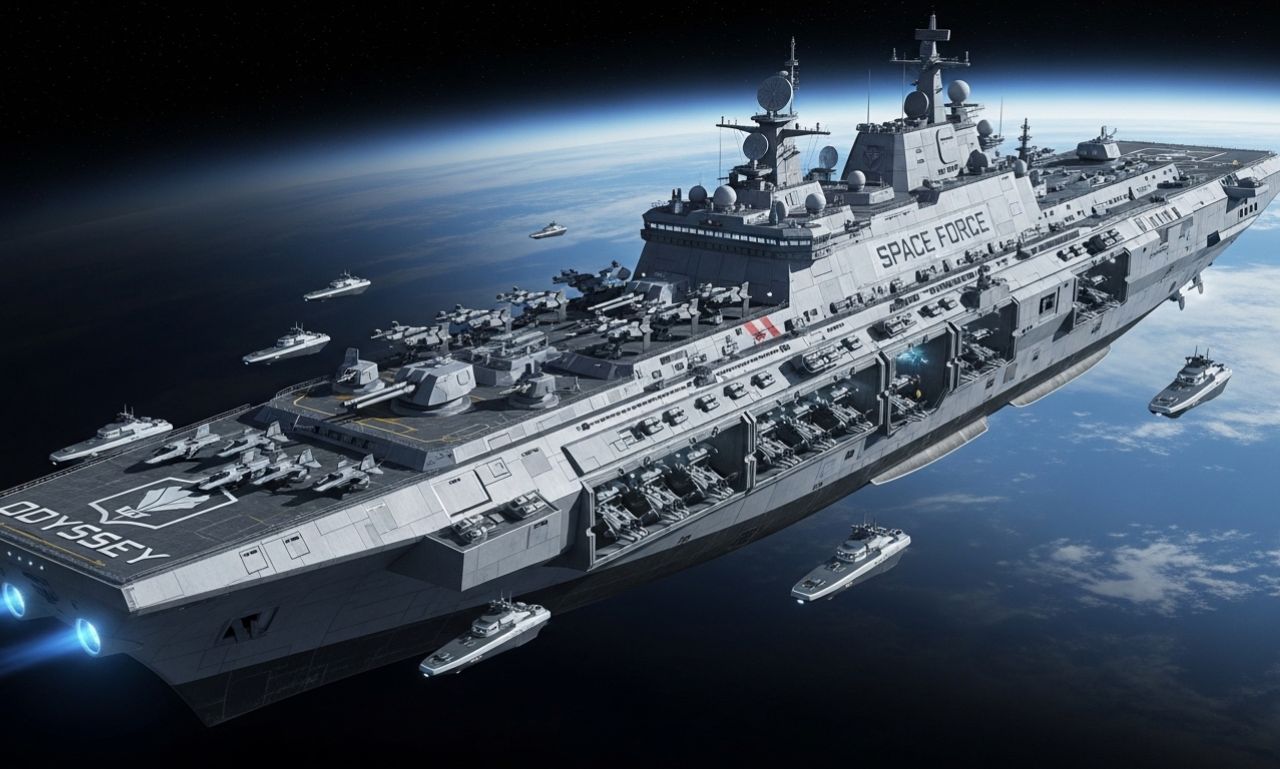
The concept of a space force orbital warship carrier has rapidly moved from science fiction into serious strategic discussion. As space becomes increasingly crowded with satellites, space stations, and commercial assets, nations are beginning to view orbit as a new domain of defense and deterrence. The idea behind a space force orbital warship carrier is to create a powerful, mobile platform capable of protecting national interests, projecting strength, and maintaining security beyond Earth’s atmosphere.
Understanding the Space Force Orbital Warship Carrier Concept
A space force orbital warship carrier can be described as a large, heavily equipped spacecraft designed to operate for extended periods in Earth orbit or beyond. Unlike traditional satellites, this carrier would function as a command hub, launch platform, and defensive shield. Its role would not necessarily be offensive, but rather to ensure dominance, surveillance, and rapid response in space.
Such a carrier would integrate advanced propulsion, artificial intelligence systems, and modular weapon or defense platforms. The aim is to provide flexibility, allowing the carrier to adapt to new threats or missions without constant redesign.
Why a Space Force Orbital Warship Carrier Is Being Discussed
The increasing dependence on satellites for communication, navigation, and intelligence has made space assets critical to national security. A space force orbital warship carrier could safeguard these assets by monitoring hostile actions and responding quickly to interference or attacks.
Space is no longer an uncontested environment. With multiple nations launching military-related satellites, the risk of conflict has grown. An orbital carrier could serve as a stabilizing presence, discouraging aggression through visible capability rather than direct confrontation.
Core Features of a Space Force Orbital Warship Carrier
A realistic space force orbital warship carrier would rely on several advanced features to remain effective and sustainable.
Advanced Propulsion Systems
Efficient propulsion is critical for orbital maneuvering. Ion engines, nuclear thermal propulsion, or next-generation electric drives could allow the carrier to change orbits, avoid threats, and reposition rapidly.
Command and Control Capabilities
As a floating headquarters, the space force orbital warship carrier would host command-and-control systems capable of coordinating satellites, drones, and support spacecraft. Secure communication networks would be essential to prevent cyber or signal-based attacks.
Defensive Technologies
Defense would likely focus on non-destructive methods such as electronic warfare, laser-based interception, and kinetic avoidance systems. These technologies could neutralize threats without creating dangerous debris fields in orbit.
Long-Term Sustainability
A carrier operating in space must support crews or autonomous systems for months or years. Life-support systems, radiation shielding, and in-orbit maintenance capabilities would be vital components of the design.
Strategic Roles of a Space Force Orbital Warship Carrier
The space force orbital warship carrier would not exist solely as a weapon. Its strategic value lies in versatility and deterrence.
Orbital Security and Surveillance
Continuous monitoring of space activity would allow early detection of hostile maneuvers. The carrier could deploy smaller surveillance units to track suspicious objects or protect high-value satellites.
Rapid Response and Support
In the event of satellite failure or attack, a space force orbital war ship carrier could dispatch repair drones or defensive escorts. This rapid response capability would reduce downtime and prevent escalation.
Deterrence Through Presence
Much like naval aircraft carriers on Earth, an orbital carrier would act as a symbol of technological superiority. Its mere presence could discourage adversaries from attempting aggressive actions in space.
Technological Challenges and Limitations
Despite its appeal, building a space force orbital war ship carrier presents significant challenges. Launch costs alone would be enormous, requiring heavy-lift rockets and multiple assembly missions in orbit.
Power generation is another obstacle. While solar energy is abundant in space, powering advanced systems and propulsion may require nuclear reactors, raising safety and political concerns. Additionally, international treaties governing space weapons could limit how such carriers are deployed or armed.
Ethical and Legal Considerations
The idea of a space force orbital war ship carrier raises important ethical questions. Space has long been viewed as a shared environment for exploration and cooperation. Militarizing orbit too aggressively could lead to an arms race, increasing the risk of conflict.
International law, including the Outer Space Treaty, emphasizes peaceful use of space. Any orbital carrier would need to balance defense requirements with global responsibility, ensuring it does not destabilize existing agreements.
Comparison to Traditional Naval Carriers
A useful way to understand the space force orbital war ship carrier is by comparing it to naval aircraft carriers. Both serve as mobile bases, project power, and support smaller units. However, space carriers operate in a far more complex environment where physics, distance, and sustainability play larger roles.
Unlike sea-based carriers, orbital carriers must account for microgravity, radiation, and orbital mechanics. These factors make design and operation significantly more challenging but also more strategically valuable.
Future Outlook for Space Force Orbital Warship Carriers
While no fully operational space force orbital wars hip carrier currently exists, research and speculation continue to grow. Advances in reusable rockets, artificial intelligence, and in-orbit manufacturing could make such platforms feasible within the coming decades.
Rather than a single massive ship, future concepts may involve distributed carriers working together as a network. This approach could reduce vulnerability while maintaining strategic coverage across multiple orbits.
Conclusion
The space force orbital wars hip carrier represents a bold vision for the future of space security. As humanity’s reliance on space infrastructure increases, so too does the need for protection and stability beyond Earth. While technical, legal, and ethical hurdles remain, the discussion surrounding orbital carriers highlights how space is evolving into a critical domain of defense. Whether as a deterrent, command hub, or guardian of vital assets, the space force orbital wars hip carrier is likely to remain a key topic in future military and technological planning.