
 By abdul aziz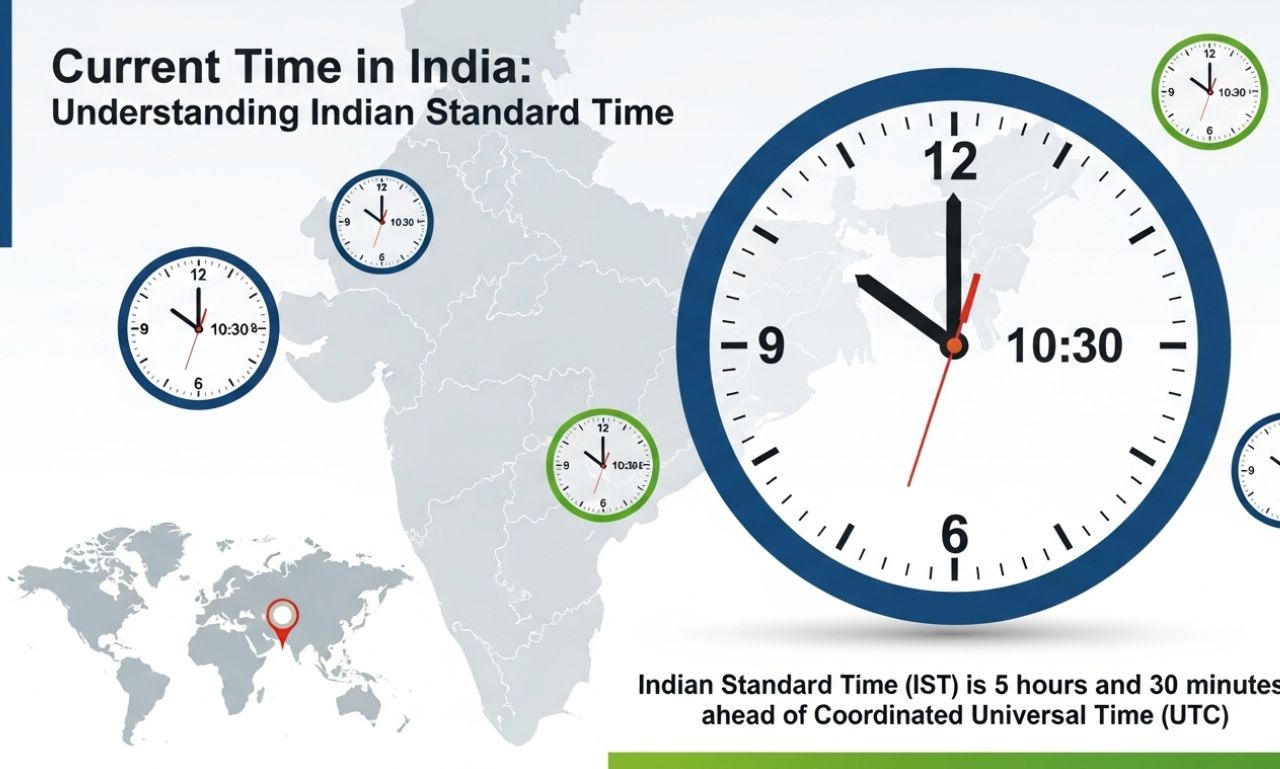
The current time in India follows a single national time zone known as Indian Standard Time (IST). Unlike many large countries that use multiple time zones, India operates under one unified time system across the entire nation. This system ensures consistency for communication, transportation, business operations, and daily activities.
Knowing the current time in India is important for international travelers, global businesses, and anyone communicating with people in the country. India’s time zone remains the same throughout the year and does not change for daylight saving time.
In this article, we will explore how the current time in India works, why the country uses a single time zone, and how Indian time compares with other major time zones around the world.
What Is the Current Time in India?
The current time in India is based on Indian Standard Time, commonly abbreviated as IST. This time zone is UTC +5:30, meaning India is five hours and thirty minutes ahead of Coordinated Universal Time (UTC).
Because India uses only one official time zone, the current time in India remains the same from the northern mountains to the southern coastline. Major cities such as New Delhi, Mumbai, Kolkata, and Chennai all follow the same standard time.
This unified system helps maintain consistency across the country’s large population and vast geographic area.
Why India Uses a Single Time Zone
Even though India is geographically wide enough to support multiple time zones, the country has chosen to use a single time standard.
The main reasons include:
National Unity
Using one time zone helps maintain uniformity across government, education, and business systems.
Simplified Scheduling
Railways, airlines, television broadcasts, and national events operate more smoothly when everyone follows the same clock.
Administrative Convenience
Managing multiple time zones can create confusion in daily life, especially in a densely populated country.
Because of these reasons, the current time in India remains consistent nationwide.
The History of Indian Standard Time
The current time in India was officially standardized during the British colonial period. Before the adoption of a unified time zone, different cities used local solar time, which varied significantly across regions.
In 1906, the government introduced Indian Standard Time based on the longitude of 82.5° East. This reference point passes near the city of Mirzapur in the state of Uttar Pradesh.
Since then, IST has remained the official time standard used throughout India.
Does India Use Daylight Saving Time?
A unique feature of the current time in India is that the country does not observe daylight saving time.
Many countries adjust their clocks forward or backward during certain seasons to extend daylight hours. However, India keeps the same time throughout the year.
This means:
-
The current time in India remains stable all year
-
Clocks do not change during summer or winter
-
Scheduling international meetings is easier to manage
Because the time never changes, IST provides a consistent system for daily life.
Current Time in India Compared to Other Countries
Understanding the current time in India becomes easier when comparing it with other major global time zones.
Here are some examples of time differences:
| Location | Time Difference from India |
|---|---|
| United Kingdom | India is 5.5 hours ahead |
| United States (Eastern Time) | India is 9.5 or 10.5 hours ahead |
| United States (Pacific Time) | India is 12.5 or 13.5 hours ahead |
| Australia (Sydney) | Australia is about 4.5 hours ahead |
| United Arab Emirates | India is 1.5 hours ahead |
These differences are important for global business meetings, international flights, and online communication.
Major Cities Following the Current Time in India
Because the entire country follows one time zone, the current time in India is identical in all major cities.
Some of the largest cities using IST include:
-
New Delhi – the capital of India
-
Mumbai – the financial center
-
Bangalore – a major technology hub
-
Hyderabad – known for IT and pharmaceuticals
-
Kolkata – an important cultural and economic city
Regardless of where someone travels within India, the time remains the same.
How to Check the Current Time in India
There are several easy ways to check the current time in India.
Online World Clock Websites
Many websites provide real-time global clocks that display the exact time in different countries.
Smartphone Clock Apps
Most smartphones automatically show the current time in India when users add it to their world clock feature.
Search Engines
Typing “current time in India” into a search engine instantly displays the exact IST time.
These tools make it easy for people around the world to track Indian time.
Importance of Knowing the Current Time in India
The current time in India is important in many situations, especially in today’s globalized world.
International Business
Companies working with Indian partners need to coordinate meetings based on IST.
Travel Planning
Travelers must adjust their schedules when flying to or from India.
Remote Work
Many global companies employ workers in India, making time coordination essential.
Online Events
Webinars, conferences, and virtual meetings often list event schedules in IST.
Knowing the correct time helps prevent confusion and missed appointments.
Interesting Facts About Time in India
Here are some interesting facts about the current time in India:
-
India’s time zone is 30 minutes different from most global time zones, which usually change by full hours.
-
The country stretches more than 2,900 kilometers from east to west, yet still uses one time zone.
-
Some northeastern regions experience earlier sunrises due to the single time system.
-
India’s standard time reference point is near Mirzapur in Uttar Pradesh.
These details make India’s time system unique compared to many other countries.
Conclusion
The current time in India follows Indian Standard Time, which is UTC +5:30. Unlike many large countries, India operates under a single time zone across the entire nation. This system simplifies scheduling, communication, and daily life for its large population.
Because India does not observe daylight saving time, the time remains consistent throughout the year. Major cities such as New Delhi, Mumbai, and Bangalore all follow the same IST clock.
Understanding the current time in India is essential for international travelers, businesses, and anyone connecting with people in the country. With modern technology and world clock tools, checking Indian time is now easier than ever.